Overview
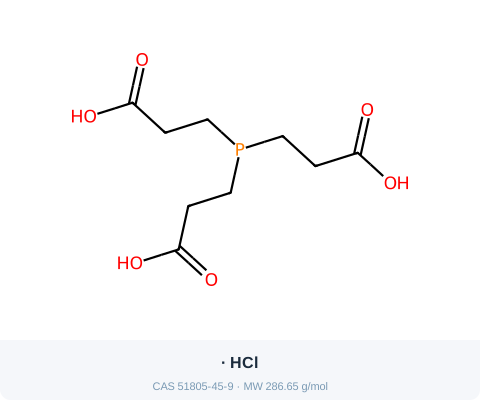
TCEP‑HCl is a non-volatile, odorless solid that reduces organic disulfides to thiols rapidly and quantitatively in water. Unlike DTT and beta-mercaptoethanol, its reaction is irreversible: the strength of the phosphorus-oxygen bond formed during reduction prevents back-oxidation, and it does not introduce free thiol groups into the reaction mixture. Even very stable alkyl disulfides are completely reduced at room temperature and pH 5 in less than five minutes. Working concentrations of roughly 5–50 mM react rapidly at room temperature without loss of selectivity.
TCEP's advantages over DTT are well documented. Its thermal stability is significantly higher, its aqueous solutions remain active over a broader pH range, and it reacts with maleimides far more slowly than thiols do, which in many workflows removes the desalting step required when DTT is used. For long-term protein storage, TCEP is often preferred because it is unreactive toward most functional groups on proteins and is compatible with many common alkylating reagents, which in favorable cases allows reduction and alkylation to be carried out together.
Applications extend into nucleic acid chemistry as well. TCEP stabilizes RNA substantially better than DTT: at elevated temperature it has been shown to more than double the half-life of full-length RNA relative to DTT or to no reductant (Rhee and Burke, Anal. Biochem. 2004, 325, 137–143). It has also been used to reduce 5′-disulfide-modified amplicons in the generation of covalently immobilized DNAs for in vitro transcription and translation (Andreadis and Chrisey, Nucleic Acids Res. 2000, 28, e5). Its higher thermal stability and ability to protect RNA against hydrolysis make it increasingly valuable in molecular biology workflows beyond classical protein biochemistry.
PolyOrganix has supplied TCEP since 2004. Each shipment includes a lot-specific Certificate of Analysis, with additional documentation available to qualified customers on request.
Quality & Documentation
TCEP supplied by Polyorganix is released against documented specifications appropriate to the order. The Certificate of Analysis identifies the tests and results applicable to the shipped lot.
Customer-specific specifications, analytical methods, documentation formats, and additional testing requirements are reviewed during qualification and confirmed with the quote or order documentation. Additional testing may affect cost and lead time.
Technical Specifications
| Typical minimum assay | ≥98% |
| Appearance | White crystalline solid |
| Solubility | Freely soluble in water |
| Molecular weight | 286.65 g/mol (HCl salt) |
| Melting point | 175–179°C |
| Shelf life | 4 years from production date under recommended storage |
| Available quantities | Custom bulk orders. Quoted on request based on quantity and lead time. |
| Documentation | Lot-specific CoA; additional documentation available on request |
Final specifications and test methods are confirmed in the applicable quote, order, or customer-approved specification.
Applications
TCEP is the industry-standard reducing agent for disulfide bond reduction prior to antibody-drug conjugate (ADC) synthesis, where precise, controlled reduction of interchain disulfides is required for site-specific drug attachment. It is also used extensively in proteomics for sample preparation, in ELISA and western blot workflows for complete protein denaturation, and in general biochemistry as a more stable, odorless alternative to DTT.
PolyOrganix serves businesses and institutions across pharmaceutical, biotechnology, industrial, and academic research sectors.
Key Reference
Burns, J.A. et al. J. Org. Chem. 1991, 56, 2648–2650. Original synthesis of TCEP as a selective phosphine reductant for disulfide bonds.
Compliance & Lot Documentation
Polyorganix provides a lot-specific Certificate of Analysis with each TCEP shipment. Traceability documentation and additional analytical information are available to qualified customers on request, subject to the applicable product and order requirements.
Polyorganix has supplied TCEP since 2004. Product specifications, testing requirements, and documentation needs are confirmed during qualification so the released material and paperwork match the customer's approved requirements.